“You know you want to, just have a go;
You’re all alone, no one will know.
Just once won’t hurt; it’s not that bad.
See, others have done it, and they’re not sad.
After all, it’s your life, you have but one.
Live for the moment—live to have fun!
Now come on, let’s do this; don’t be a hater,
Besides you can always repent and change later.”
Thus, listening to Satan spread precepts of sin;
And lured by his lies, at last you fall in.
Then covered in filth in your sorry state
You see at last but, alas, it’s too late.
So you hop in the tub to wash it away,
But when the water drains, some things stay.
For the Devil, that dog, this is his goal—
To leave a scum ring on your soul.
* * * * *
In alarmed desperation, you scrub at the stain;
Yet in spite of your efforts, the rings still remain.
So, you try even harder, but to no avail;
Left on your own, you will certainly fail.
And then you hear it—the laughing hiss:
“Well, well well! Will you look at this!
No one will ever love you now!”
Then in defeat, you conquered bow.
Stripped of halo, stripped of wings,
Replaced by sinful scummy rings.
You’ll pass through life a hollow shell,
Destined for the depths of hell . . . .
Yet, there is One who still can clean
Even the very worst rings you’ve seen.
It is He that can pull you out of hell’s hole
And take the scum rings from your soul.
I was probably nine or ten, I don’t remember exactly. It was a hot summer evening, and we were flood irrigating sweet corn. The stalks were tall and green and the rows were just wide enough that my little brother and I could run and slide in the slick mud and water. Reflecting back on the moment as an adult, it seems like such a bad idea for a multitude of reasons. And yet, I can still remember the pure delight of the moment.
And the mud. I remember the mud. It was clay soil which means it sticks to you. And we were covered in it—from head to foot and everywhere, I mean everywhere in between. When we were finished, Mom sprayed us off with the garden hose and then sent us to have a bath. But even with the initial rinse, we still left a mess in the tub.
A while back, I was in the middle of writing another poem when I had this interesting thought about sudsy scum rings left behind in a bath tub. It didn’t fit with the poem I was working on, so I made a note to myself. I later came back and wrote the first half of this poem. I considered it done and moved on. However, in the weeks that followed, a lesson I gave to the youth at church some time ago came to mind, and I realized the poem was incomplete and needed a second half.
In the lesson, I showed a cardboard door with shapes cut into it representing keyholes titled Celestial, Terrestrial, Telestial, and Hell. I also had a small wooden board that was the “key”. The board represented the individual life of each class member. I told them we each have a key; and depending on what we do in life, determines which slot the key will fit into and what door it will open to the kingdom of glory we will receive.
I told them that as we go through life we sin. In my object lesson, sins were represented by nails. Every time we sin we put a nail in our board. To demonstrate, I said that sassing their parents was a sin because they were not honoring them like the scriptures say. I pounded a small nail in the board. With the nail there, it would not allow the board, or key, to fit in the straight and narrow “Celestial Kingdom” keyhole. We read, “For the Lord cannot look upon sin with the least degree of allowance” (D&C 1:31). It does not matter how little or how long ago it happened, ANY sin will prevent us from accessing heaven.
We went through a list of sins, sins of omission and commission. Lesser sins were represented by smaller nails and worse sins by large nails. The placement of nails allowed or denied access to kingdoms, though in every case they allowed access to Hell because “wide is the gate, and broad is the way, which leadeth to destruction” (3 Nephi 14:13).
We then read this comforting declaration, “Behold, he who has repented of his sins, the same is forgiven, and I, the Lord, remember them no more” (D&C 58:42). We discussed how when we repent, the justice and atonement of Christ (represented by the hammer which satisfies justice by pounding the nail in the board in the first place and mercy by removing it when we repent) removes the nails.
With all the nails removed, the board now fit in the Celestial Kingdom slot again. I then asked if the board looked like it did when we started. They say no, because though the nails are gone, the board is pocked with holes the nails left behind. I point out the biggest hole, one caused by a large sin we spent some time discussing and asked them what caused that hole. They all remembered. I said, “But wait, I thought the scripture said when we repent we don’t remember them anymore?” We discussed how it is God who says He will not remember them but we still do. We discussed the value in remembering to help prevent us from repeating it. We also discussed how just because we repent does not mean that we do not have lasting effects from the sin, just like the holes in the board.
I also made sure to discuss that the Devil knows what caused the holes. He will bring it up often, and at the most inopportune times. I cautioned them to remember that in our example the nail is the sin, NOT THE HOLE! Satan will try to confuse this distinction to prevent our progress. When we have repented and been forgiven, we can move forward—in spite of the hole left behind.
While preparing the lesson, I got to this point and thought I was done. However, something in the back of my mind was nagging at me. Something did not feel quite right. So, I did some more pondering and found two final scriptures that changed everything.
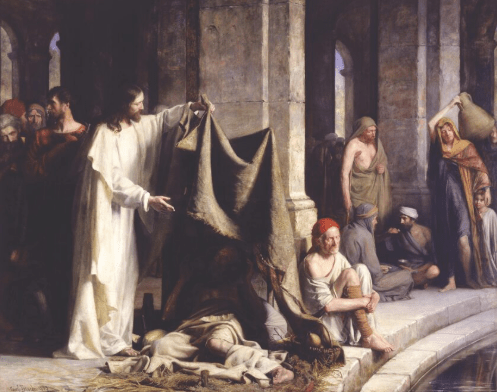
During Christ’s mortal ministry he visited the pool of Bethesda where he sees a man with an ailment who had suffered for thirty-eight years. This episode is tenderly captured by the famous painting by Carl Bloch. Yet it is the question Christ asks that stood out to me: “When Jesus saw him . . . he saith unto him, Wilt thou be made whole?” (John 5:6). In my mind, came the thought, “Whole means without hole.” Then from the prophet Moroni comes his final testimony: “Come unto Christ, and be perfected in him . . . [and] if ye by the grace of God are perfect in Christ, and deny not his power, then are ye sanctified . . . that ye become holy, without spot” (Moroni 10:32-33).
Back in class, I flip the board or “key” over to reveal the unblemished, unmarred underside. Perhaps it will not be until long after we leave this mortal existence that our final transformation and “upgrade” is complete. But I am reminded again that the Atonement of Christ is not just to reclaim, but to redeem. It is not just to pardon, but to perfect; not just to save, but to sanctify; not just to erase, but to exalt. Someday, amazingly, those who choose will be made whole. Complete. Without spot.
Written: May 20, 2018
 Once Upon A Rhyme