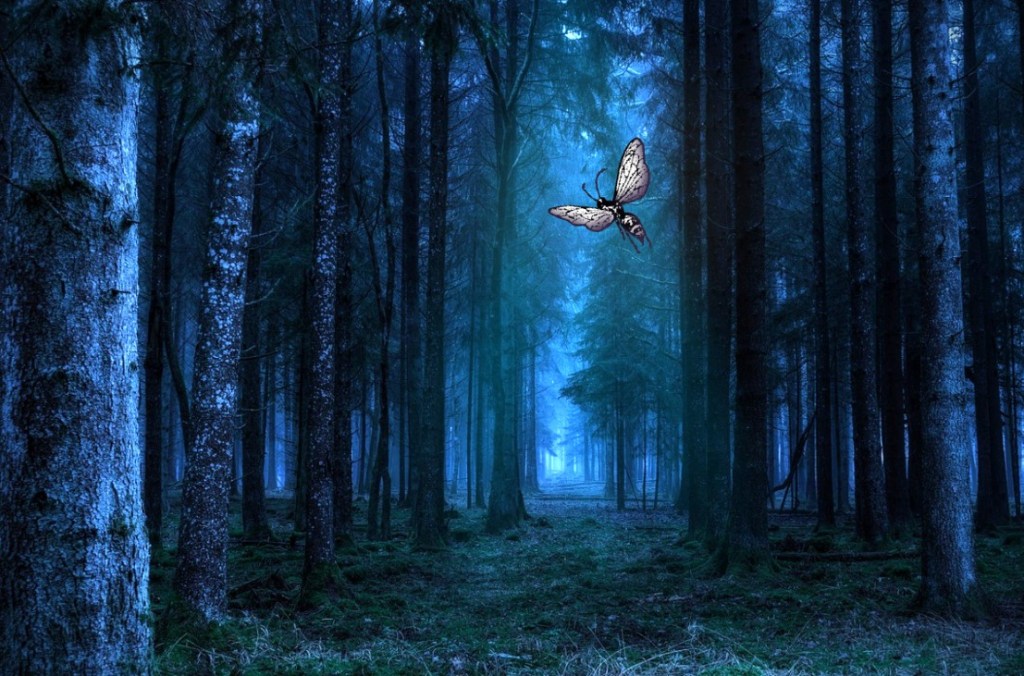
“Now this is living!” says the wasp, with wings outstretched in flight;
The small fig orchard, still and calm, is bathed in soft moonlight.
Against advice, given thrice, he ventured to this place;
“The old fool doesn’t know,” he mocks, in a quickened, defiant pace.
Besides, his friends were talking; and he wants to come and see—
The whispered nighttime mystery, rumored in this old tree.
Suddenly he gets a waft of something—delicious, sweet, and strange;
At once intoxicated, his course he could not change.
This smell he must discover! From where does this scent come?
And then he hears melodic voice with sultry little hum.
From way up high inside a fig, he sees a light dimmed low,
Silhouetting gorgeous form, beckoning soft and slow.
How recklessly he flies to her! With all the haste of sin!
And gladly hears her silken words, “Hello, won’t you come in?”
Inside seductive figgy house, by pure allure he’s led;
And then the way they both embrace, all reason leaves his head.
This female he just has to have—he must, he must, he must!
And so with morals tossed aside, he falls to carnal lust . . . .
Too late he learns that it’s a trap, too late to now depart;
For warningless, she turns on him and stings him to the heart.
She casts his broken body on an ever-growing pile;
And for the first time, now he sees, what was there all the while—
A mound of crumpled corpses, from all her lovers past,
And slowly realization dawns that he won’t be her last.
For already she has tidied up her fatal figgy tomb
And stands inside the doorway, wafting that strange perfume.
Again he hears her sultry words, “Hello, won’t you come in?”
And knows another victim’s there—and she’s about to win.
With all his strength he tries to scream, but breath just isn’t there;
So as his final, silent act, he sighs the word: “Beware!“
Ficus carica, that is the Latin name. The Latin name for what you ask? Fig. Such a long and awkward word for our simple three-letter English one. Just think how hard it would be every time you wanted one of those delicious little cookies with crunchy filling: “Please pass the ficus carica newtons,” you would have to say. I will just stick with fig, thank you.
I remember the first time I ever had a fig newton. I was maybe ten or twelve when I discovered this tasty treat. What was this creation and where had it been all my life? Fast forward about 15 years. I was nearing the end of my college career and needed one more life science general elective. Scanning the list of choices, I saw Plant Biology and went with it. It was a fascinating class, but I was earning an engineering degree with a math minor and this little general elective was one of the hardest classes I took. First, it was death by PowerPoint every class period; and second, every minuscule detail was fair game for the test. But the real crime was the day I learned the truth about the fig.
Figs are pollinated by the female fig wasp. The female brings pollen from another source and enters the fig through a small opening. She runs around the inside of the fig laying eggs and scattering pollen in the process. Then she dies—inside the fruit. The eggs left behind develop and a new generation of wasps emerge. The males and females mate and then the females leave to seek out new figs to lay eggs while the males stay and die—again inside the fruit. You know that crunch, crunch when you eat a fig newton . . . ? Now, the smart scientists say the fruit decomposes and absorbs all those little wasp bodies and that crunch you experience is just fig seeds. R-i-g-h-t . . . . Maybe I will just get Oreos next time I am in the grocery store cookie aisle. (Thankfully, my professor let us know that most commercial figs are not wasp pollinated, so, in theory, fig newtons should be safe.)
Between the process of fig pollination and the life cycle of several other insects, it got me thinking how this relates to the gospel. I took some liberties with the fig wasp and came up with the concept in this poem. The surface story is clearly that of immorality and involves elements of curiosity, arrogance, rebellion, and passion. It also involves the concepts of “too dark, too late, too alone” which is where immorality thrives. However, the more subtle message is that of our relationship with God and the Devil.
God wants what is best for us and has set boundaries and parameters. The Devil is continuously trying to get us to cross the line. Whether it deals with morality, the word of wisdom, time management, callings, anger, pride, or any other topic, Satan wants to lead us away from what is right. He is clever and seductive; and so often before we realize the trap, we are caught. And just like the wasp, we die spiritually because “The Lord cannot look upon sin with the least degree of allowance” (Alma 45:16). Thankfully, in God’s wisdom, love, and grace, there is a way for us to be forgiven and made clean and whole again. Not just that, we can become perfect. We all sin differently and have different weaknesses and temptations. True, some sins are greater than others; but every time we turn to Christ, we realize, again, that, unlike the little wasp, it is not too late for us.
Ficus carica newtons anyone?
Written: January 15, 2017
 Once Upon A Rhyme